The Digital Story of Spain’s 2026 FIFA World Cup Triumph
12 reading minutes
22/07/2026
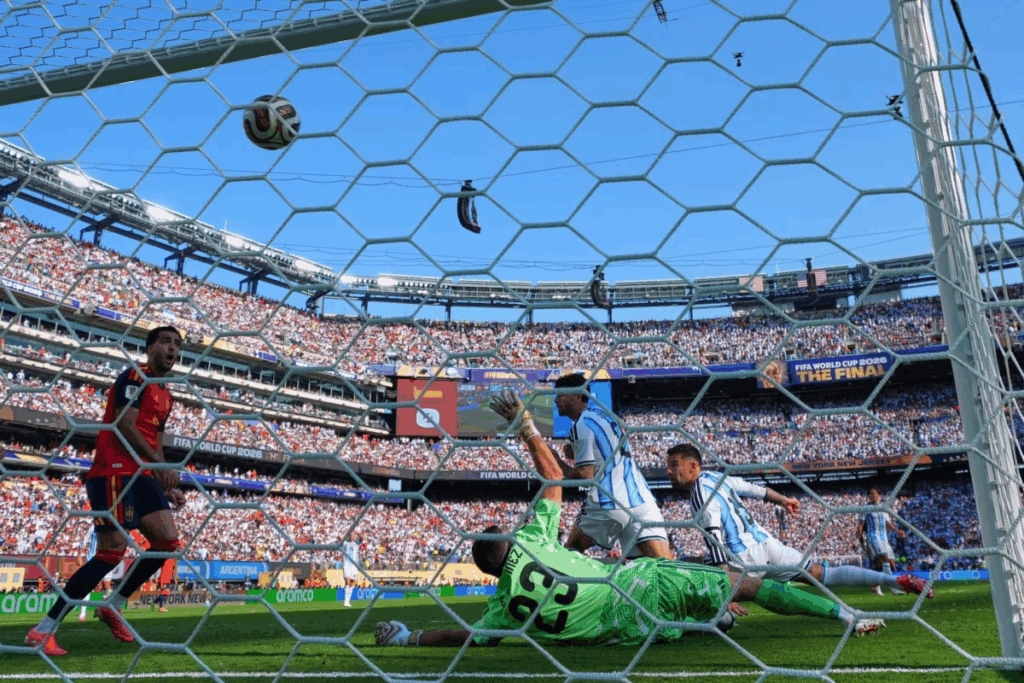
The 2026 FIFA World Cup crowned the Spanish National Team as world champions while simultaneously generating intense activity across social media, digital media and other online platforms. Every match, every individual performance and every event involving the team left an immediate footprint in the digital ecosystem, shaping a narrative that evolved from the opening match to the celebration of the world title.
At Ikerfel, we monitored this conversation throughout the tournament using Social Listening technology, analysing more than 1.5 million mentions related to the Spanish National Team. This monitoring made it possible to identify not only when the main peaks of attention occurred, but also which players, events and brands captured the interest of fans, media outlets and content creators.
Throughout this report, we analyse the evolution of the conversation, the prominence of the different players, the media impact of their performances and, as a new feature, the visibility achieved by the National Team’s official sponsors. The result provides a quantitative view of how the digital narrative that accompanied Spain on its journey to World Cup glory was built.
The conversation surged with Spain’s World Cup triumph
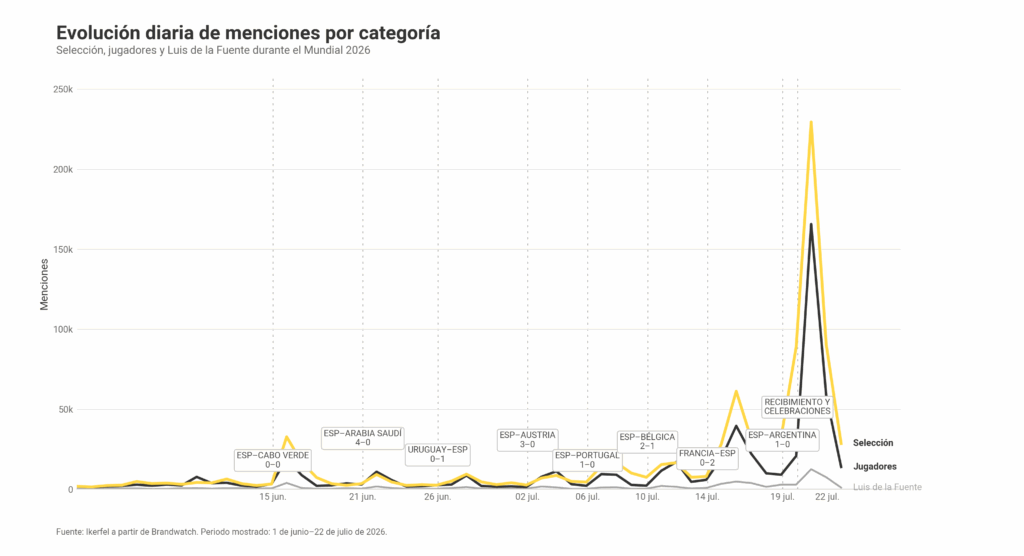
The daily evolution of mentions shows how the conversation gained momentum as the tournament progressed. During the group stage and the early knockout rounds, activity was concentrated mainly around matchdays, with occasional peaks linked to the team’s performances and the outcome of each game.
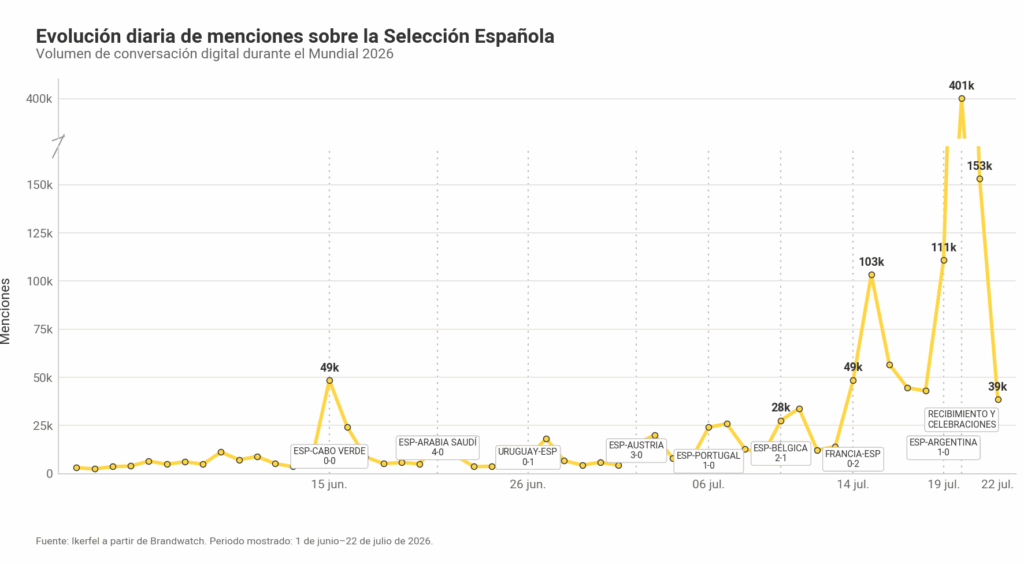
The first major peak occurred with Spain’s opening match against Cape Verde, generating nearly 49,000 mentions. From that point onwards, the conversation followed an irregular pattern driven by each fixture, although it began to grow more steadily during the decisive knockout rounds. The quarter-final victory over Belgium and, especially, the semi-final win against France significantly increased attention, surpassing 100,000 mentions after the latter and foreshadowing the sharp rise that would accompany the final.
Spain’s victory over Argentina in the World Cup final marked a turning point. More than 111,000 mentions were recorded around the decisive match itself, but the highest volume across the entire period did not occur during the game. Instead, it came the following day, coinciding with the team’s homecoming and victory celebrations. On that day alone, approximately 401,000 mentions were recorded—almost four times the peak generated by the final itself.
The conversation revolved around the National Team but gradually shifted towards its key players
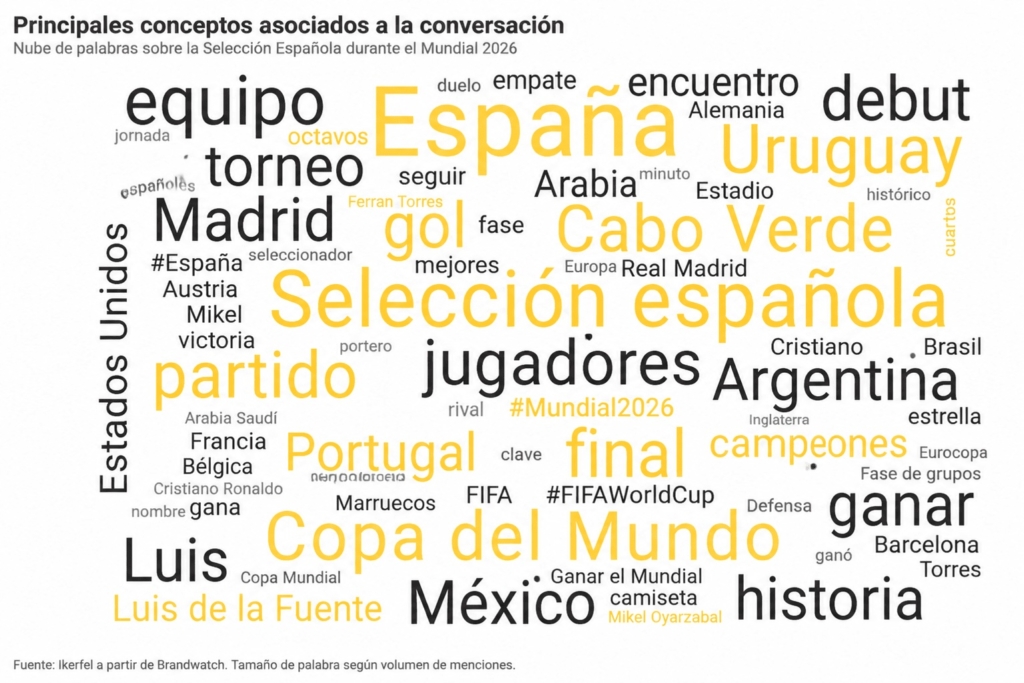
The conversation generated throughout the 2026 FIFA World Cup clearly centred on the Spanish National Team. The word cloud shows that the most prominent concepts are directly linked to the team and the competition, with terms such as Spain, Spanish National Team, team, players and World Cup occupying the most visible positions. Alongside them appear Spain’s main opponents—Cape Verde, Uruguay, Portugal, France and Argentina—as well as concepts such as final, champions, history and win, illustrating how the narrative evolved from following the matches to celebrating the world title.
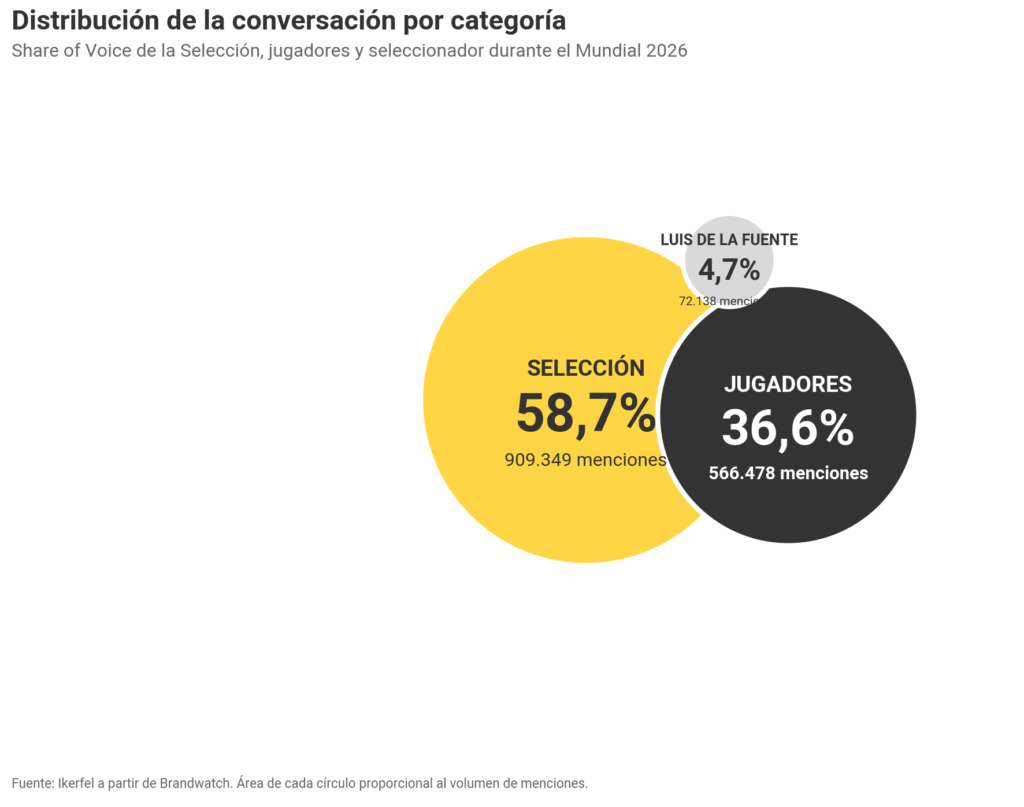
This is confirmed by the distribution of the conversation. The Spanish National Team itself accounted for 909,349 mentions, representing 58.7% of the total analysed. Players generated 566,478 mentions (36.6%), while head coach Luis de la Fuente accumulated 72,138 mentions (4.7%). The team therefore remained the central narrative axis throughout the tournament.
However, the evolution over time reveals a particularly interesting pattern. Although the National Team maintained its leadership throughout the competition, attention devoted to individual players increased progressively as Spain advanced through the knockout rounds. Individual performances gained increasing relevance, reaching their highest level after the final.
Winning the World Cup and the subsequent celebrations represented the moment of greatest intensity throughout the tournament. While conversation about the National Team reached its historical peak, discussion surrounding the players also experienced extraordinary growth, fuelled by the celebrations, interviews and the widespread sharing of player-related content.
Lamine Yamal led the conversation, although the spotlight shifted throughout the tournament
The individual analysis shows that Lamine Yamal was, by a considerable margin, the player who generated the largest volume of conversation during the World Cup. His 207,895 mentions placed him comfortably ahead of the rest of the squad, establishing him as the team’s main media figure throughout the competition.
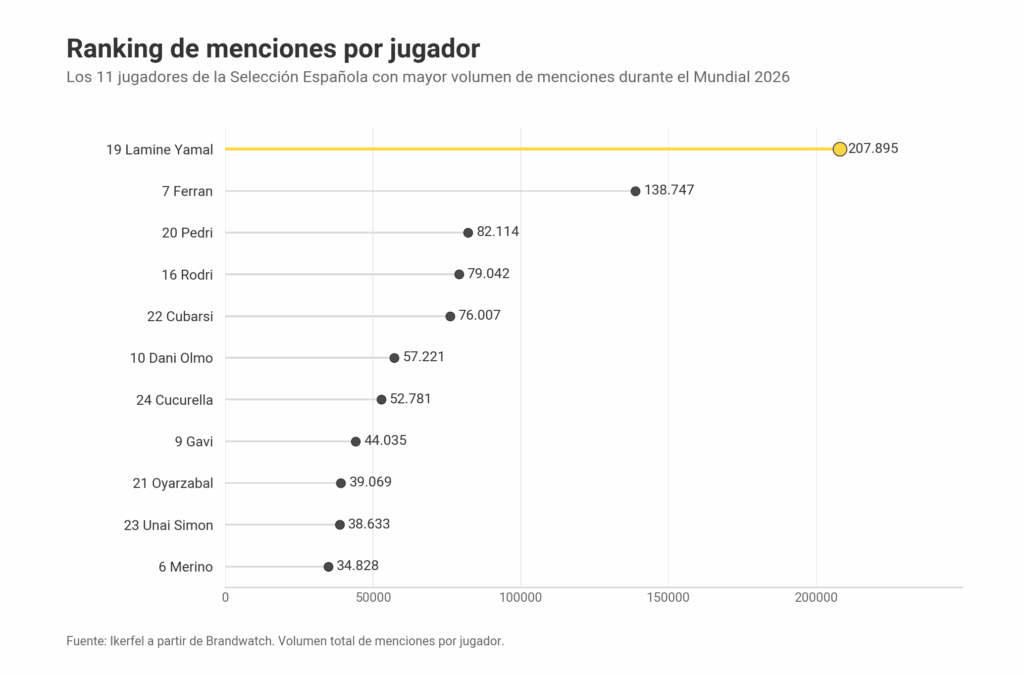
He was followed by Ferran Torres with 138,747 mentions, ahead of Pedri (82,114) and Rodri (79,042). The Top 11 is completed by Pau Cubarsí, Dani Olmo, Marc Cucurella, Gavi, Mikel Oyarzabal, Unai Simón and Mikel Merino, all of whom generated significant levels of conversation thanks to their involvement in key moments of the tournament.
The timeline reveals, however, that this leadership was not constant from the beginning. During the group stage, attention was distributed relatively evenly among several players, with peaks associated with standout performances in individual matches. As Spain progressed through the knockout rounds, certain players gradually captured a larger share of public attention.
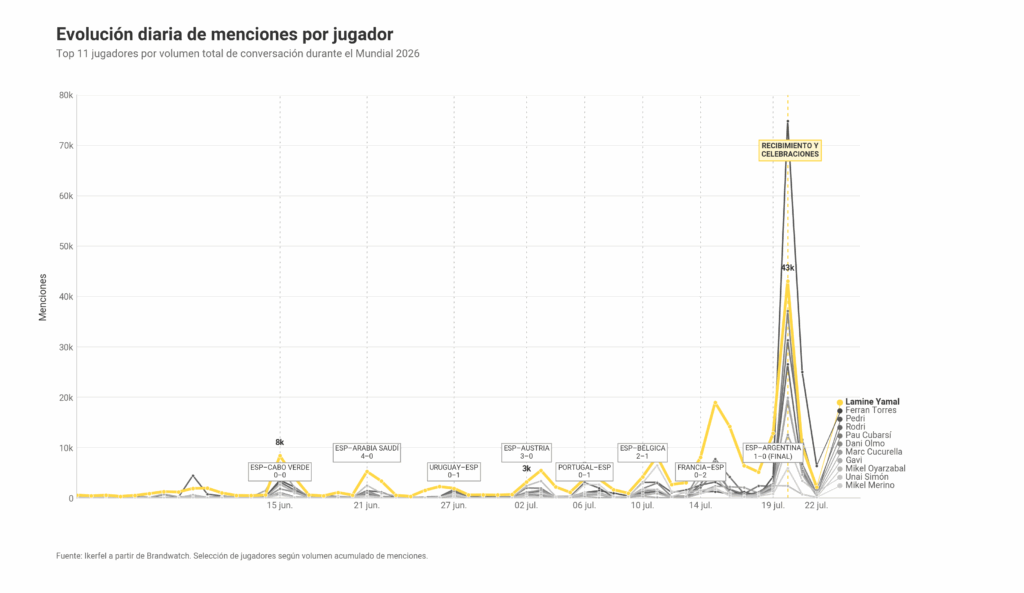
The biggest shift came after Spain’s World Cup victory. The celebrations dramatically increased the visibility of the team’s leading figures. In this context, Lamine Yamal once again stood clearly ahead of the rest, although the chart also shows that much of the squad experienced significant increases in visibility, demonstrating how sporting success amplified the profile of the entire team.
Which players generated the most conversation per minute played?
The total number of mentions indicates which players attracted the greatest attention during the World Cup. However, this metric is influenced by each player’s time on the pitch. To complete the analysis, both variables were combined by calculating the number of mentions per minute played, considering only players who participated for at least 90 minutes during the tournament.
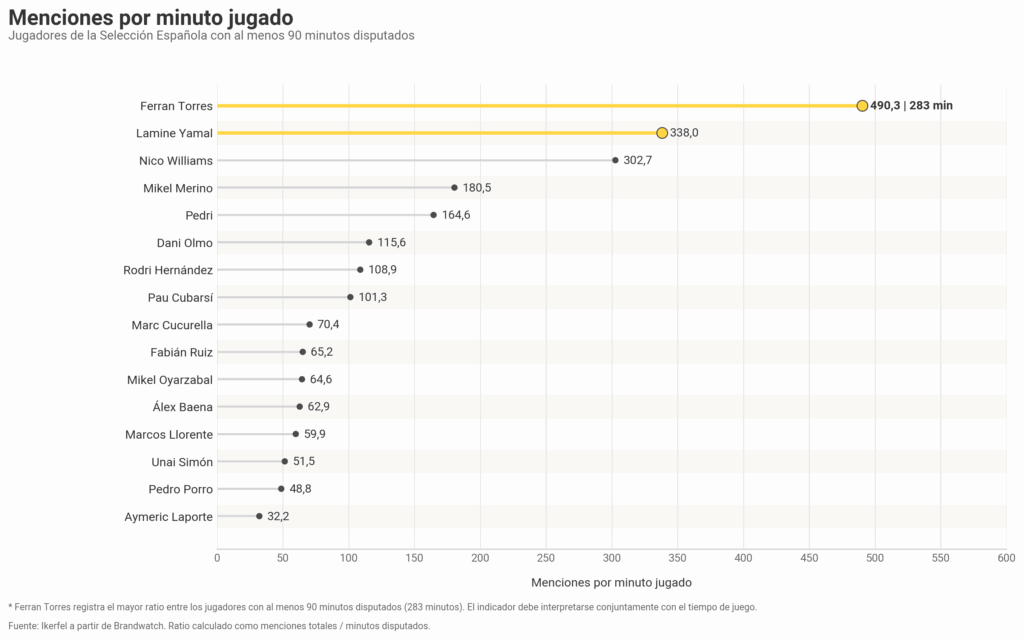
Under this criterion, Ferran Torres tops the ranking with a ratio of 490.3 mentions per minute—a particularly remarkable figure considering that he played 283 minutes during the competition. He is followed by Lamine Yamal (338.0 mentions per minute) and Nico Williams (302.7).
Lamine Yamal’s ratio is especially noteworthy because it was sustained across 615 minutes of playing time, reflecting a consistently high media profile throughout the tournament. By contrast, Nico Williams’ position should be interpreted in light of the fact that he played only 108 minutes, meaning that a relatively limited amount of playing time concentrated a high level of digital attention per minute.
A second group consists of Mikel Merino, Pedri and Dani Olmo, while players who featured consistently throughout the tournament—such as Rodri, Pau Cubarsí, Marc Cucurella, Fabián Ruiz, Mikel Oyarzabal and Unai Simón—recorded more moderate ratios.
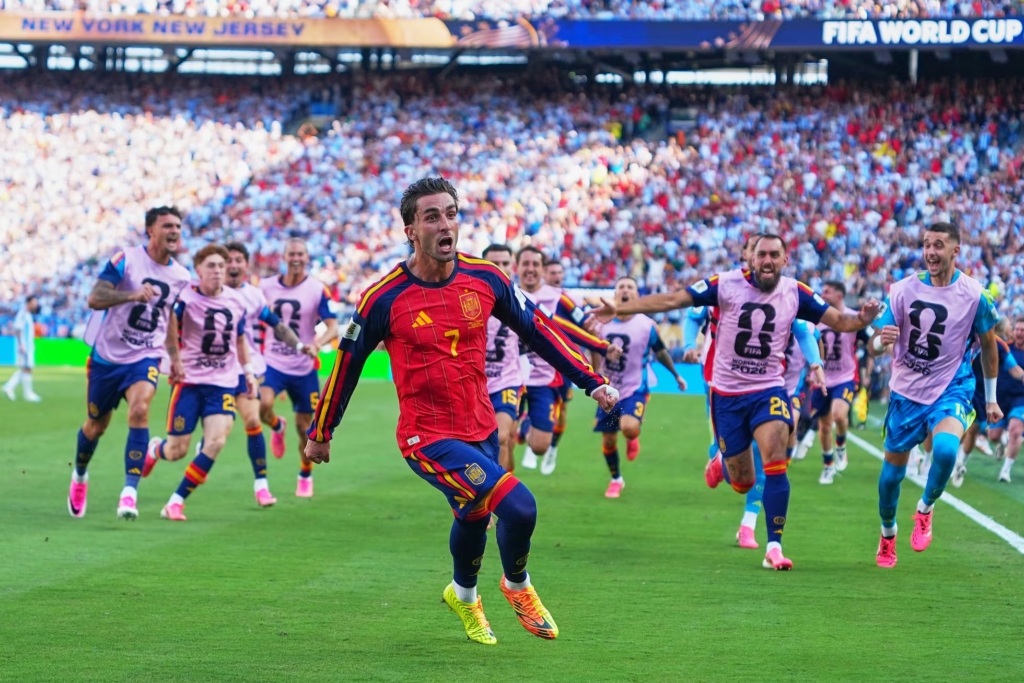
This indicator helps identify those players capable of generating particularly intense media impact relative to their sporting contribution. Ferran Torres perfectly illustrates this phenomenon. Although he was not among the players with the highest number of minutes played, scoring the goal that secured Spain’s second World Cup title generated enormous media attention and dramatically increased his mentions-per-minute ratio. Consequently, this metric should always be interpreted alongside playing time, as it reflects not only consistency on the pitch but also the ability of decisive moments to multiply a player’s visibility.
What return did the official sponsors obtain?
The conversation surrounding the Spanish National Team also extended to the brands associated with it. Although sponsors generated far fewer mentions than either the team itself or its players, the analysis makes it possible to identify which companies achieved the greatest spontaneous visibility within the tournament’s digital narrative.
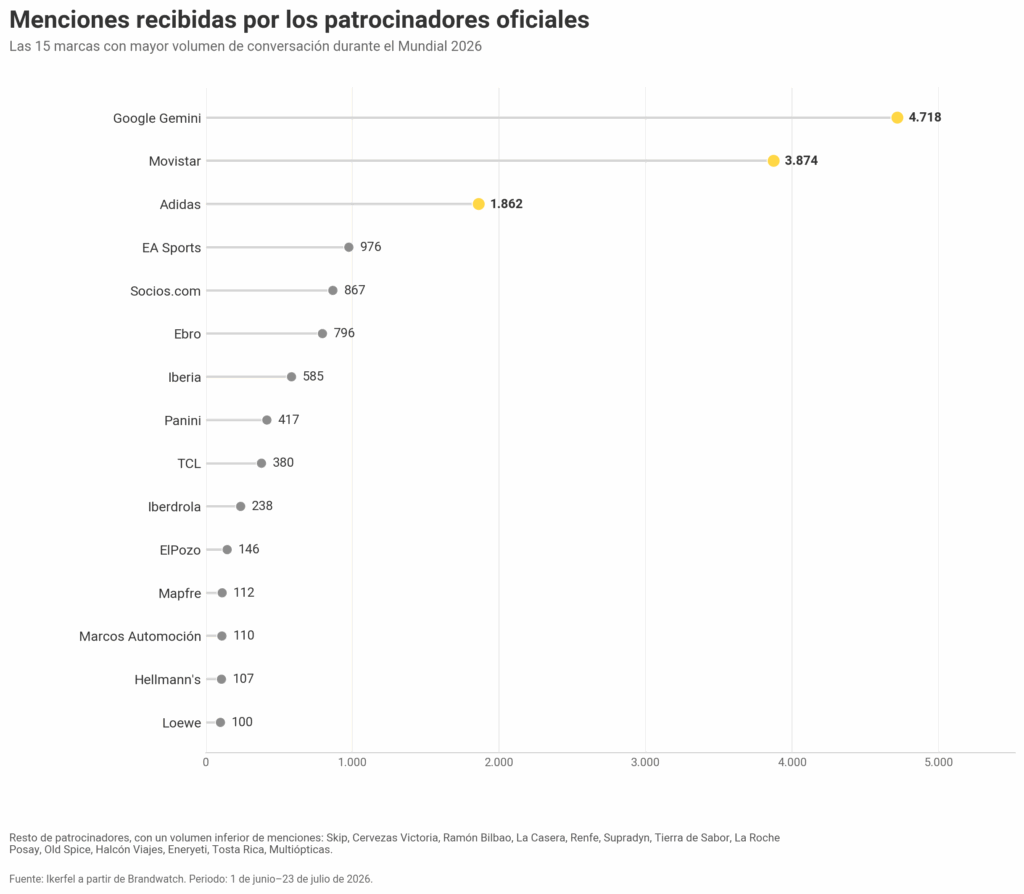
Google Gemini leads the ranking with 4,718 mentions, followed by Movistar (3,874) and Adidas (1,862). These three brands account for a substantial share of all conversations related to the National Team’s official sponsors.
Some way behind come EA Sports, Socios.com, Ebro and Iberia, while the remaining sponsors generated considerably lower volumes. These differences show that the visibility achieved depends not only on being an official sponsor, but also on each brand’s ability to become part of the conversation through campaigns, activations or spontaneous associations made by users.
It should be noted that this analysis considers only explicit mentions of each sponsor within the monitored conversation. It therefore measures the direct visibility achieved by brands during the World Cup but does not include other forms of return, such as visual exposure during broadcasts or through advertising assets.
The results demonstrate that an event of the World Cup’s magnitude not only generates conversation around sporting performance but also provides associated brands with an opportunity to increase their visibility and become part of the narrative surrounding Spain’s success.
Conclusions
Winning a second World Cup title represented far more than a sporting achievement for the Spanish National Team. It also generated one of the largest digital conversations ever associated with Spanish sport. Throughout the tournament, Ikerfel monitored this conversation using Social Listening technology, identifying how the narrative evolved from match-by-match coverage to the collective celebration of the world title. Over the course of the competition, more than 1.5 million mentions were generated, creating a digital conversation ecosystem of extraordinary scale.
The analysis shows that this narrative was built on different levels. The Spanish National Team remained the central focus of the conversation, while individual players gained increasing prominence as the tournament progressed. In this context, Lamine Yamal and Ferran Torres represent two different ways of capturing public attention: the former through sustained visibility throughout the tournament, and the latter through the extraordinary media impact of scoring the goal that secured Spain’s second World Cup title.
The World Cup’s impact also extended well beyond the pitch. Sponsors, institutions and media organisations all became part of an ecosystem in which sporting success amplified the visibility of every stakeholder associated with the National Team, creating opportunities for brand exposure that went far beyond the sporting result itself.
Ultimately, this study highlights the value of market research in understanding how the narrative surrounding a major sporting event is constructed and in measuring its impact from multiple perspectives. Tools such as Social Listening transform millions of spontaneous conversations into structured intelligence, identifying the moments that drive discussion, the key protagonists who capture public attention and the visibility achieved by associated brands. Combined with other research methodologies, this information provides a more comprehensive understanding of the real impact of events of this scale and offers a robust foundation for data-driven decision-making.